

TOEFL Registration Site
TOEFL Registration Site
Increased conversion by 2.8x for a global high-stakes test registration platform
E-Commerce | Conversion/Growth | Accessibility (WCAG)
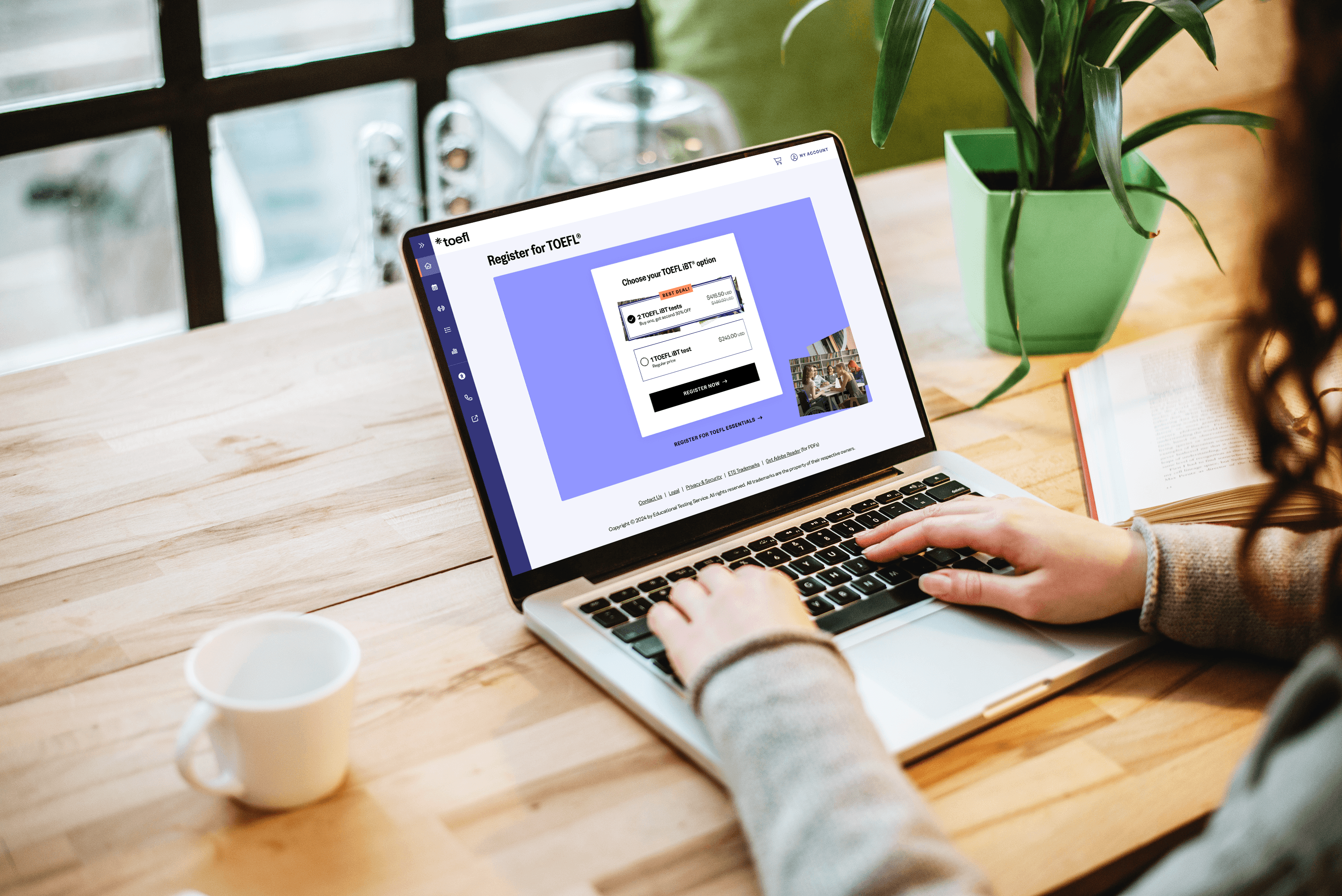
Led end-to-end redesign of a global high-stakes test registration platform. Simplified core flow (sign up, test scheduling, and checkout), resulting in 5x faster task completion and 8.8% increase in Average Order Value (AOV).
Overview
The TOEFL iBT® is an English language proficiency test enabling millions of people worldwide to pursue higher education and immigration abroad, and is a primary revenue driver for ETS.
The TOEFL registration site is a critical touchpoint, but the platform needed modernization to meet evolving business demands and user expectations. I led UX efforts to improve clarity, accessibility, and usability under tight timelines and high executive interest—balancing short-term conversion goals with long-term strategy.
Key Results

2.8x increase in conversion rate—1.9% to 5.3%
8.8% boost in average order value (AOV)—$170 to $185
5x faster task completion—from 15+ to 3-4 minutes
Improved user-centered processes
Enhanced accessibility
My Role:
UX design
UI design
Design team lead
UX strategy
Duration:
7 months
Team:
PM, UX designers, UX researcher, developers, business systems analysts, technology leads. Regularly consulted with marketing and accessibility specialists.

Challenge
The test registration site had undergone incremental updates over the years, but legacy issues persisted. Research revealed significant pain points: it took most users over 15 minutes to complete registration. A TOEFL rebrand had also been unveiled, and new competitors, like Duolingo, were gaining market share.
Our stakeholders’ expectations were to: increase revenue, reduce time on tasks, and create a more competitive experience—fast. With a preference for 'ship and measure', we had limited time and budget for traditional user-centered design processes.

Solution
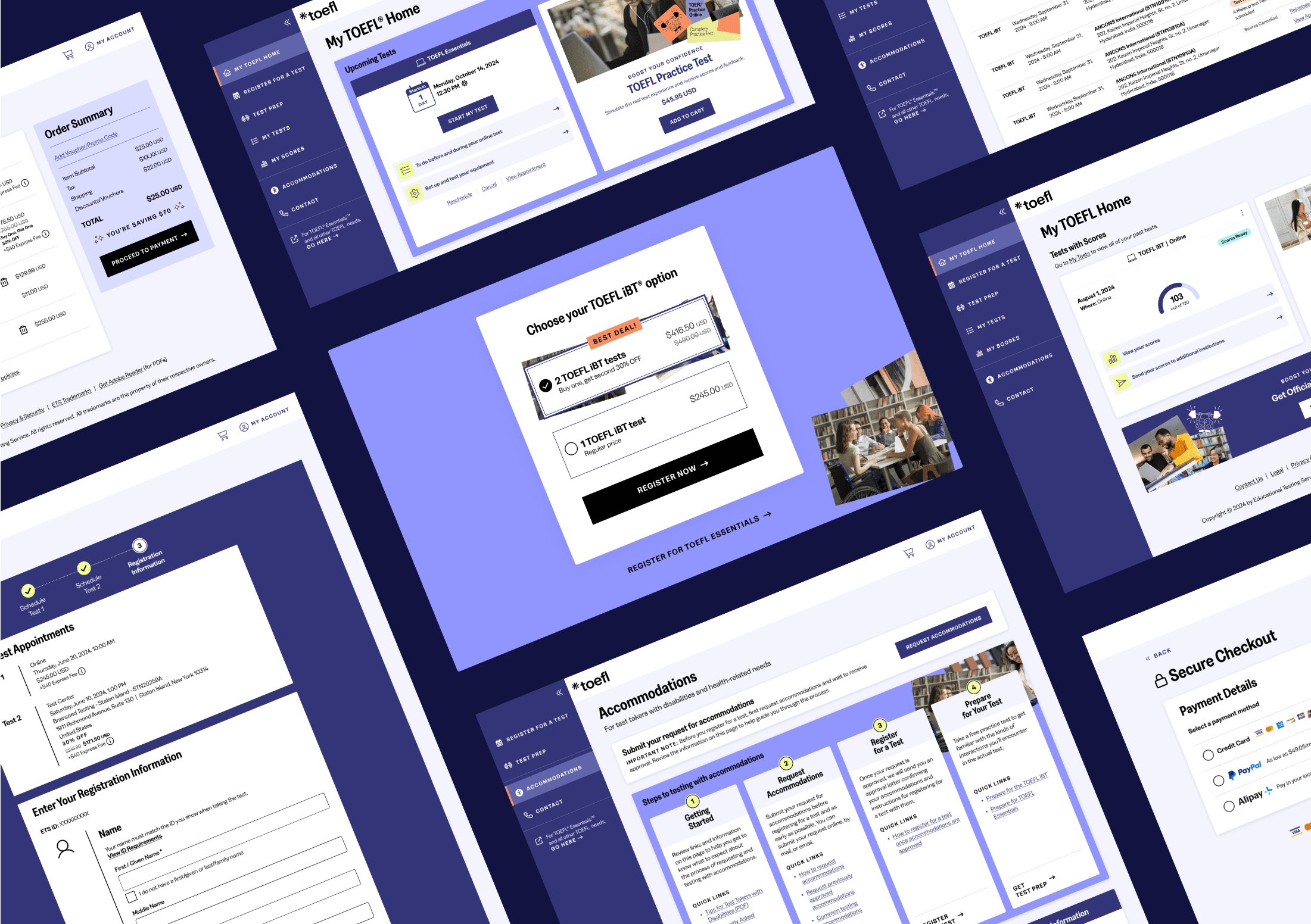
A scalable information architecture and streamlined core user flow helped users realize value faster. I made it faster and easier for users to get through the test registration process from sign up to checkout, and used lifecycle segmentation to provide a personalized experience that brought the relevant revenue-generating features and critical time-sensitive actions to the surface.
Features:
Shortened sign-up flow
Simplified scheduling and registration flow
Optimized checkout
Personalized home page
Restructured information architecture
Accommodations "hub" for users with disabilities
Promotional and new product experiments
“
The results speak for themselves: Michelle's redesigned TOEFL registration flow reduced time to register for an exam by more than half and increased both the overall conversion rate & the average order value per test taker.
— Lead Product Manager

Approach
We needed to be creative, strategic, and laser-focused. The following approach helped ensure a smooth process and solid decision-making.
Phased delivery
We planned to deliver the core flow within the first 60 days, and then iteratively deliver the rest of the site, reaching parity within 7 months.
Resource-effective research
I reviewed recent research, got in touch with customer service, performed competitive analyses, and conducted heuristic reviews to keep things moving, while simultaneously collaborating with our UX researcher to identify research needs that we could conduct rapidly.
Design for scalability
Taking a proactive and systems-thinking approach, I analyzed and proposed a streamlined information architecture that can evolve gracefully. This enabled us to redesign the structure from the start and build onto it rather than having to recreate it from scratch.
Accessible from the start
I worked closely with our internal accessibility specialist to ensure designs and implementation were universally usable. I made sure users with disabilities were included in our feedback loops so that we weren't just making assumptions, but creating genuinely inclusive experiences.
Approach
We needed to be creative, strategic, and laser-focused. The following approach helped ensure a smooth process and solid decision-making.
Phased delivery
We planned to deliver the core flow within the first 60 days, and then iteratively deliver the rest of the site, reaching parity within 7 months.
Scrappy (but not crappy) research
I reviewed recent research, got in touch with customer service, performed competitive analyses, and conducted heuristic reviews to keep things moving, while simultaneously collaborating with our UX researcher to identify research needs that we could conduct rapidly.
Design for scalability
Taking a proactive and systems-thinking approach, I analyzed and proposed a streamlined information architecture that can evolve gracefully. This enabled us to redesign the structure from the start and build onto it rather than having to recreate it from scratch.
Accessible from the start
I worked closely with our internal accessibility specialist to ensure designs and implementation were universally usable. I made sure users with disabilities were included in our feedback loops so that we weren't just making assumptions, but creating genuinely inclusive experiences.
Unlock the full story
You might also like:
You might also like:
You might also like:
What are your business or product goals?
Let's have chat about your needs.


What are your business or product goals?
Let's chat about
your needs.
Overview
The TOEFL iBT® is an English language proficiency test enabling millions of people worldwide to pursue higher education and immigration abroad, and is a primary revenue driver for ETS.
The TOEFL registration site is a critical touchpoint, but the platform needed modernization to meet evolving business demands and user expectations. I led UX efforts to improve clarity, accessibility, and usability under tight timelines and high executive interest—balancing short-term conversion goals with long-term strategy.
Key Results
2.8x increase in conversion rate—1.9% to 5.3%
8.8% boost in average order value (AOV)—$170 to $185
5x faster task completion—from 15+ to 3-4 minutes
Improved user-centered processes
Enhanced accessibility
2.8x increase in conversion rate—1.9% to 5.3%
8.8% boost in average order value (AOV)—$170 to $185
5x faster task completion—from 15+ to 3-4 minutes
Improved user-centered processes
Enhanced accessibility
My Role:
UX design
UI design
Design team lead
UX strategy
Duration:
7 months
Team:
PM, UX designers, UX researcher, developers, business systems analysts, technology leads. Regularly consulted with marketing and accessibility specialists.
Challenge
The test registration site had undergone incremental updates over the years, but legacy issues persisted. Research revealed significant pain points: it took most users over 15 minutes to complete registration. A TOEFL rebrand had also been unveiled, and new competitors, like Duolingo, were gaining market share.
Our stakeholders’ expectations were to: increase revenue, reduce time on tasks, and create a more competitive experience—and fast. With a preference for 'ship and measure', we had limited time and budget for traditional user-centered design processes.
Solution
Users needed to get to value faster. Our solution removed much of the legacy friction that slowed down their journey and delivered a streamlined sign up flow, personalized the experience to bring the most relevant information and steps to the surface, prioritized accessibility, and put customers' needs first.
Features:
Shortened sign-up flow
Simplified scheduling and registration flow
Optimized checkout
Personalized home page
Restructured information architecture
Accommodations "hub" for users with disabilities
Promotional and new product experiments
Approach
We needed to be creative, strategic, and laser-focused. The following approach helped ensure a smooth process and solid decision-making.
Phased delivery
We planned to deliver the core flow within the first 60 days, and then iteratively deliver the rest of the site, ultimately reaching parity within a 7 month period.
Scrappy (but not crappy) research
Sometimes getting an initial lay of the land means being resourceful. I reviewed recent research, got in touch with customer service, performed competitive analyses, and conducted heuristic reviews to keep things moving, while simultaneously side-baring with our UX researcher to identify future research needs that we could conduct quickly.
Prioritize scalability
Taking a proactive and systems-thinking approach, I analyzed and proposed a streamlined information architecture that can evolve gracefully. This enabled us to redesign the structure from the start and build onto it rather than having to recreate it from scratch.
Accessible from the start
I worked closely with our internal accessibility specialist to ensure designs and implementation were universally usable. I made sure users with disabilities were included in our feedback loops so that we weren't just making assumptions, but creating genuinely inclusive experiences.