Converse Workplace
Designed and launched AI-powered learning app from 0–1 to validate product-market fit
0–1 Product | AI / NLP | Mobile Design
Defined the end-to-end UX for a corporate R&D concept and advocated for a lean launch to test core assumptions. Optimized the post-launch onboarding flow to increase user completion and engagement.


Challenge
With declining sales in English language testing (TOEFL and TOEIC). Our team was tasked with identifying new revenue opportunities in English-language learning while supporting AI capabilities teams in developing innovative technology.
User research revealed a key insight: English learners in India wanted to improve their speaking proficiency but felt anxious about practicing with more fluent speakers. This created a paradox—they understood practice would help them improve, but they were hesitant for fear of judgment. Additionally, learners lacked clarity on which specific speaking sub-skills needed development and how to improve them effectively.

Solution
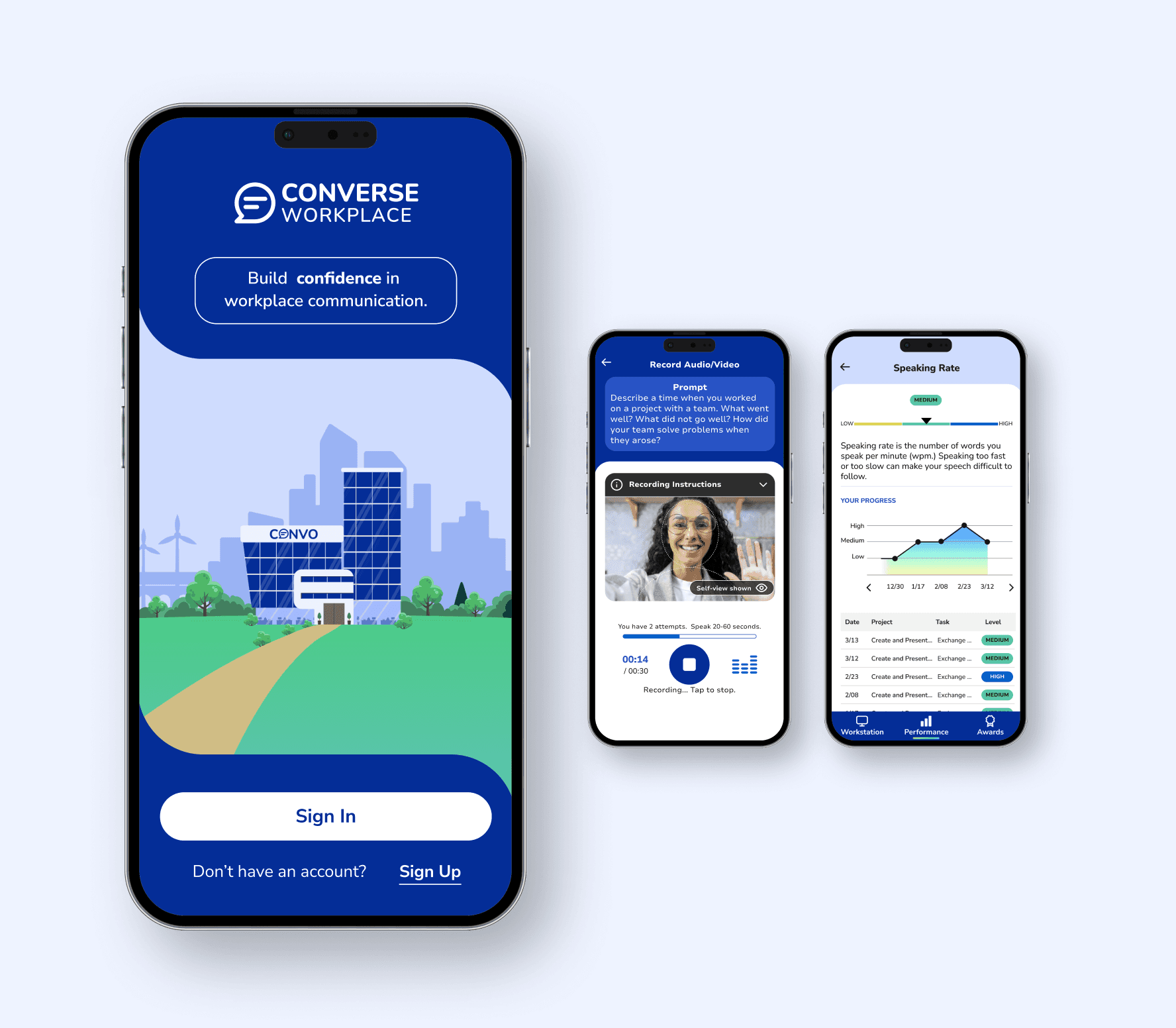
Converse: Workplace is an English-language learning app that helps people develop their communication skills through simulated scenarios and AI-powered feedback through Natural Language Processing (NLP). It offers a judgment-free, fictional workplace environment, where users can practice with characters instead of real people, helping them gain confidence and the specific skills needed to secure and succeed in English-speaking jobs.
“
"It corrects your mistakes instantly and give you an opportunity to learn things again with new examples. Interface was clean and easy to understand. Anyone can learn things without any difficulty"
— User research participant

Approach
Visual design strategy & design system
Lay the foundation with a design system, including UI kit, reusable item templates, and standardized information architecture to enable consistency and rapid prototyping while supporting fast-paced, large scope development.
Build an innovation pipeline
Ideas are gold on innovation projects. We needed to establish a method to sustain a flow of ideas to support scientists and instructional designers who were in charge of developing item types and assessments.
Clarity, alignment, & prioritization
When starting at 0, the possibilities can be overwhelming and the requirements can be vague. Getting clear on expectations and using prioritization methods helped us define which features to focus on next.
Ship, measure, & iterate
I advocated for launching with core features rather than waiting for multiple learning paths, enabling us to learn while developing. This approach became our go-to-market strategy.